Monolithic & Risk-Era Building Assessments

Specialist Due Diligence For Higher-Risk Homes

Helping purchasers understand observable weathertightness risk indicators, building condition, and maintenance considerations before making a purchase decision.

Buying A Monolithic-Clad Or Risk-Era Building?

Some homes deserve a closer look before purchase.

This is particularly true for properties constructed during New Zealand’s recognised weathertightness risk era, including many monolithic-clad and plaster-clad homes featuring design elements commonly associated with increased weathertightness risk.

Features such as limited eaves, complex roof forms, parapets, enclosed decks, internal gutters, and direct-fixed cladding systems can increase the importance of understanding a property’s condition before committing to a purchase.

A Monolithic & Risk-Era Property Assessment provides purchasers with a focused, non-invasive assessment of observable risk indicators and general building condition.

The purpose is not to confirm that a property is free from defects.

The purpose is to help purchasers better understand observable risk, maintenance considerations, and whether further specialist investigation should be considered to support your due diligence process.

Is This Assessment Right For Your Property?

This assessment may be suitable if:

  • The property has been described as monolithic-clad, plaster-clad, or a higher-risk home
  • The property was built during the 1990s or early 2000s
  • A bank, broker, solicitor, or adviser has recommended additional due diligence or requested an assessment from a suitably qualified independent professional
  • You have concerns about weathertightness, moisture, or future maintenance costs
  • You want more information than a standard building inspection alone may provide
  • You are unsure whether additional investigation may be required

This assessment sits between a standard Pre-Purchase Building Inspection and a specialist Weathertightness Survey, helping purchasers determine whether additional investigation may be warranted before proceeding with a purchase.

Monolithic Property Assessment

Understanding Risk Indicators

Many monolithic-clad and risk-era homes continue to provide satisfactory service.

However, certain construction methods, design features, and maintenance conditions are recognised as increasing the likelihood of weathertightness-related issues developing over time.

The purpose of this assessment is to identify and comment on observable risk indicators present at the time of inspection.

A risk indicator does not automatically mean a building has failed.

Likewise, the absence of visible concerns does not confirm that concealed defects, moisture damage, or weathertightness issues are not present.

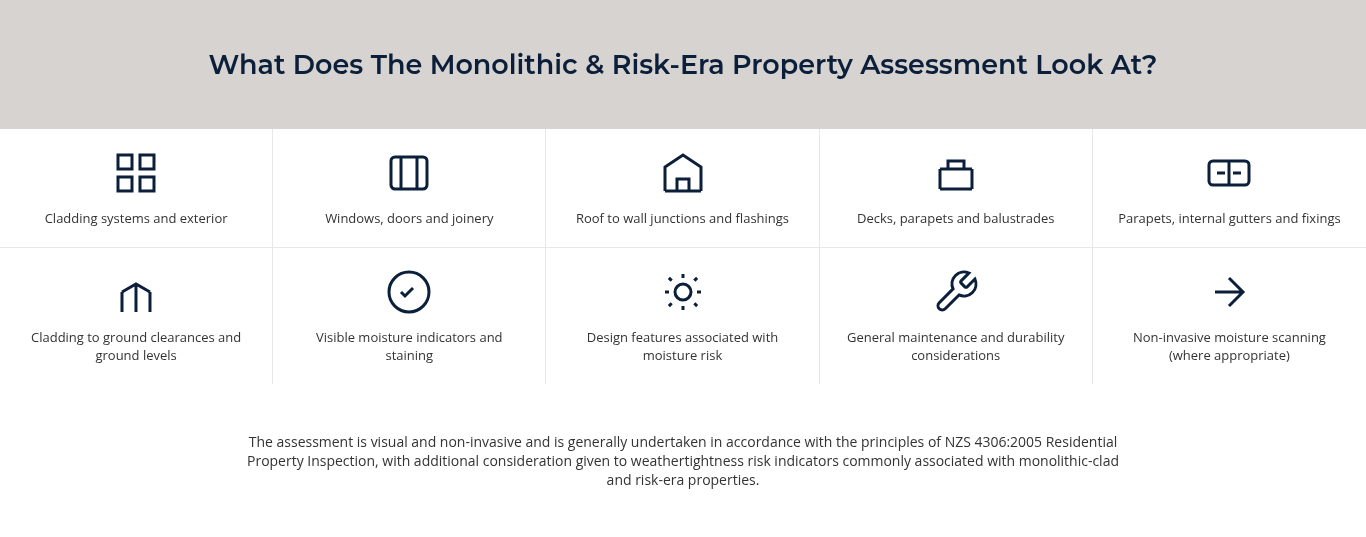
The report records observations made from accessible areas during a visual, non-invasive inspection and should be considered within the limitations of that service.

Moisture Scanning

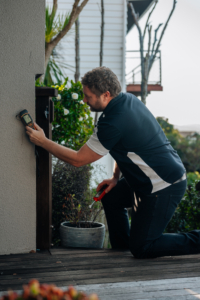
Where appropriate, non-invasive moisture scanning may be used as an indicative assessment tool.

Moisture readings require professional interpretation and should always be considered alongside the building’s construction, condition, environmental exposure, and other relevant observations.

Non-invasive moisture scanning can assist in identifying areas that may warrant further consideration. However, it does not provide the same level of certainty as invasive investigation.

Inquest moisture scanning

How This Assessment Fits Into The Due Diligence Process

For many purchasers, a Monolithic & Risk-Era Building Assessment provides sufficient information to support the purchasing decision.

However, where elevated moisture readings, visible deterioration, significant risk indicators, or other concerns are identified, further investigation may sometimes be appropriate.

The assessment can be viewed as a first-stage due diligence service that helps purchasers determine whether additional investigation is warranted and, if so, what form that investigation should take.

Where additional certainty is required, purchasers may be referred to Inquest Limited for specialist Building Surveyor services, including Weathertightness Surveys, Invasive Moisture Investigation, Damage Surveys, Remediation Planning, and Cost To Rectify Inclusion™ (CRI™) assessments.

Not every building will require further investigation. The objective is to ensure that any additional assessment is proportionate to the level of risk identified and the information required to support the purchasing decision.

Frequently Asked Questions

In these situations, the lender may require information from a suitably qualified independent professional to assist in assessing the property’s condition and any associated risks.

A Monolithic & Risk-Era Property Assessment can help purchasers obtain additional information about the property’s observable condition and risk indicators before proceeding with a purchase.

Where findings suggest increased concern, further investigation may be recommended.

Depending on the circumstances, purchasers may be referred to Inquest’s specialist Building Surveyor team for further investigation and advice.

Yes. Many buyers use the findings to support price negotiations, repair requests, or equitable set-off under the ADLS Sale and Purchase Agreement (Clause 10). However, we recommend you seek legal advice when relying on reports for contractual claims. You can read more about that on our blog.

No. A risk indicator does not automatically mean a property has weathertightness defects or moisture damage.

The purpose of the assessment is to identify and comment on observable risk indicators present at the time of inspection.

Where concerns are identified, further investigation may be recommended to obtain a higher level of certainty.

It depends on the nature of the defect. Minor maintenance or non-structural repairs may not require consent, but issues involving weathertightness, structure, or code non-compliance often do. We’ll flag any areas that may require further investigation and can carry out a building file review on request.

Yes. Many purchasers choose this assessment when considering properties that present increased weathertightness risk or where additional investigation is desirable before a purchase becomes unconditional.

Absolutely. Many clients find it helpful to be on site at the end of the inspection for a walkthrough or summary. This allows you to ask questions in context before receiving the full written report.  You will need to advise on booking so we can co-ordinate timings

No. The assessment is visual and non-invasive and cannot confirm the absence of concealed moisture damage or weathertightness defects.

Likewise, the absence of visible concerns does not confirm that concealed defects, moisture damage, or weathertightness issues are not present.

Where concerns are identified, further specialist investigation may be recommended.

Book A Monolithic & Risk-Era Building Assessment

Contact your local Inquest inspection partner to discuss the property and determine whether this assessment is appropriate for your circumstances.